
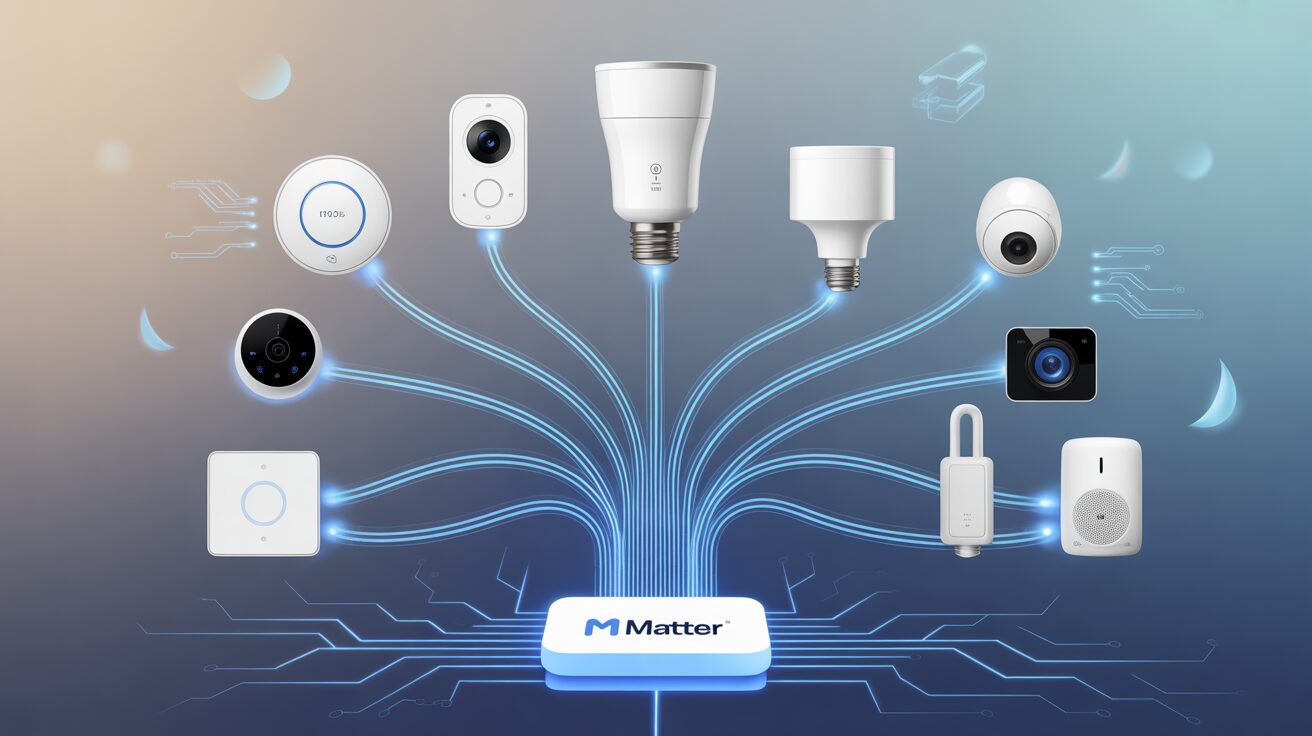
Matter & Device Interoperability
Executive summary
Matter is an IP-based connectivity standard created to solve the smart home’s biggest problem: devices from different brands don’t reliably work together.
Matter’s promise is simple for consumers—buy a device with the Matter logo and it should work across major ecosystems (Apple, Google, Amazon, Samsung/SmartThings) with local control as a core design goal.
In practice, Matter is driving growth because it reduces three major friction points:
-
Setup complexity (fewer proprietary pairing workflows; standardized commissioning)
-
Ecosystem lock-in (more cross-platform compatibility)
-
App overload (more control through a chosen “home” app rather than one app per brand)
At the same time, Matter is not “magic.” The experience depends on (1) whether your platform supports the device type you bought, (2) whether the device is native Matter or bridged through a hub, and (3) the maturity of multi-admin and Thread networking in your home.
1) What Matter is (and what it is not)
What it is
Matter is a smart home application-layer standard under the Connectivity Standards Alliance (CSA). It is designed so manufacturers can build devices that are compatible with major smart home and voice platforms.
Key technical characteristics that matter (in plain language):
-
IP-based: built to run over your home’s IP networks.
-
Runs on common transports: initially Wi-Fi and Thread, and can also use Ethernet in relevant products; Bluetooth LE is used for commissioning/pairing.
What it is not
-
Matter is not a single “hub” brand. It’s a standard many brands implement.
-
Matter does not automatically make every feature of a device portable across ecosystems (advanced features can be limited by what the Matter spec and each platform exposes).
-
Matter doesn’t eliminate the need for controllers/hubs—it often changes which hub you need and how much it can unify.
2) Why interoperability matters: the problems Matter is trying to fix
A. Easier setup and cross-brand compatibility
Historically, each brand had its own pairing steps, app, cloud account, and “works with” limitations. Matter standardizes onboarding and control so devices can join a home more consistently across platforms.
What improves for users:
-
fewer “is this compatible with my phone/assistant?” surprises
-
more consistent setup flows
-
more predictable baseline behaviors (on/off, brightness, lock/unlock, sensor states, etc.)
B. Reduced need for multiple apps
Matter is designed so users can manage devices from a primary home app (Apple Home / Google Home / Alexa / SmartThings), rather than installing a separate app for every device brand—especially for basic control.
You may still use a manufacturer app for:
-
firmware updates
-
advanced device settings
-
features not exposed through Matter (varies by category and brand)
C. More devices that “just work together”
Matter’s biggest promise is lowering the “smart home tax” of mixing brands. In theory, it becomes reasonable to choose the best device per category (lock from Brand A, lights from Brand B, sensors from Brand C) and still have one coherent system.
3) How Matter interoperability actually works in a home
Understanding three roles makes Matter much less confusing:
A. Matter Controller
A Matter controller is the thing (or app/platform) that can add and manage Matter devices. Different ecosystems act as controllers (Apple Home, Google Home, Alexa, SmartThings), usually through specific hubs/speakers/displays/routers that support Matter.
B. Matter Device
A device can be:
-
Native Matter: the device itself speaks Matter.
-
Bridged to Matter: a hub exposes non-Matter devices to Matter ecosystems (common for legacy Zigbee product lines).
C. Multi-admin (one device, multiple ecosystems)
Multi-admin is the capability for a device to be shared across ecosystems (e.g., one Matter device accessible via both Apple Home and Google Home). The “Enhanced Multi-Admin” improvements are specifically called out in Matter 1.4 coverage as a step toward making that original promise easier.
Reality check: multi-admin experiences still vary by platform and device category, but the direction is clear: less lock-in.
4) Matter’s evolution: why the spec updates matter
Matter isn’t one static standard; it expands device categories and capabilities over time.
Matter 1.3 (May 8, 2024)
CSA highlights additions including energy reporting, water & energy management, EV chargers, and new major appliances.
Why it matters: This is where interoperability starts moving beyond “lights and plugs” into meaningful home infrastructure—utilities, safety, and larger appliances.
Matter 1.4 (Nov 7, 2024)
CSA positions 1.4 as expanding home energy management by adding device types such as solar panels, batteries, heat pumps, and water heaters, plus improvements that support smarter energy automation.
Why it matters: Interoperability is becoming an energy platform story, not just a convenience story.
5) Thread + Wi-Fi: the networking layer behind “it just works”
Matter commonly rides on:
-
Wi-Fi (good for higher bandwidth, already everywhere)
-
Thread (low-power mesh networking, designed for sensors and battery devices)
Thread is important because it helps enable reliable, low-power device connectivity at scale (lots of sensors, buttons, contact sensors, etc.). Matter 1.4 discussions also emphasize improvements around network infrastructure and Thread support.
What this means for buyers: A “Matter device” may still have different real-world performance depending on whether it’s Wi-Fi Matter or Matter-over-Thread and whether your home has Thread border router support.
6) IKEA as a real-world example: making Matter mainstream
IKEA is a strong case study because it targets affordability and scale, and it’s explicitly moving its smart home lineup toward Matter.
DIRIGERA as controller + bridge
IKEA introduced Matter support for the DIRIGERA hub as a way to simplify and broaden compatibility—so devices connected to DIRIGERA can work with Matter platforms.
Expansion of Matter-compatible devices (lights, sensors, plugs, controls)
IKEA announced a new range of 21 Matter-compatible products focused on lighting, sensors, and control—positioned as making smart home tech easier and more accessible.
This directly supports the trend points you listed:
-
Easier setup and cross-brand compatibility (Matter positioning in IKEA announcements)
-
Reduced need for multiple apps (users can manage via their chosen Matter ecosystem app for core functions)
-
More devices that “just work together” (IKEA’s emphasis on broad compatibility + affordable expansion)
7) Current limitations (important for a truly “comprehensive” view)
Matter is a big step forward, but there are still practical constraints:
-
Device-type support varies by ecosystem
Even if the Matter spec supports a category, the platform you use may lag in support or expose fewer features. -
Bridged devices may have “baseline” functionality
Bridging is great for compatibility, but advanced brand-specific features may not translate cleanly across ecosystems. -
Multi-admin isn’t perfectly frictionless yet
Matter 1.4 pushes improvements, but user experience still differs by platform and implementation. -
Firmware and certification maturity
The “it just works” promise depends heavily on solid implementation and updates from manufacturers and platform providers.
8) Practical guidance: how to benefit from Matter now
If you’re advising buyers or planning product assortments, these are the most useful rules of thumb:
-
Buy Matter for the categories Matter already does well (lighting, plugs, basic sensors, etc.), and verify your chosen ecosystem supports the specific device type.
-
If you’re building a sensor-heavy home, consider Thread-friendly ecosystems (because Thread improves reliability for low-power devices).
-
Prefer devices that clearly state native Matter vs Matter via hub/bridge (both are valid; they just behave differently).
-
If cross-platform access matters (Apple + Google household), look for products and ecosystems that support smoother multi-admin workflows.